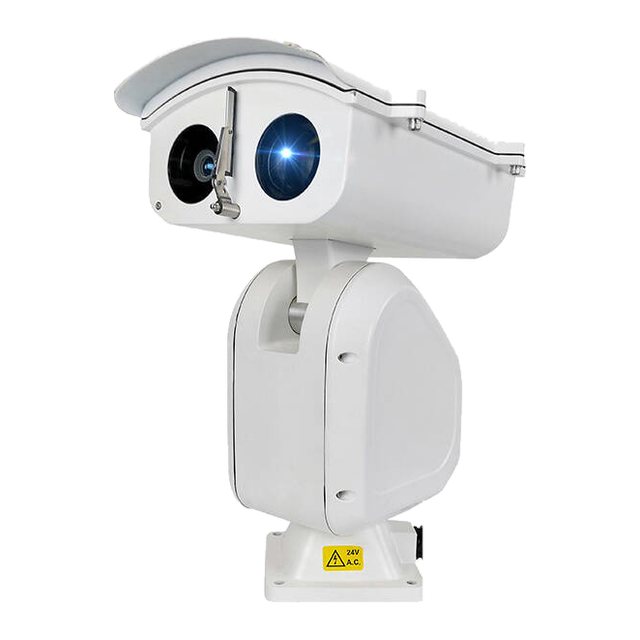
Introduction
Laser and infrared PTZ cameras are both used to monitor areas that have little or no visible light, but they are not interchangeable technologies. Infrared LED illumination is broad, economical and effective across many short-to-medium-range applications. Laser illumination can concentrate energy into a narrower beam that follows a telephoto lens, making it more suitable for demanding long-range observation. Neither option is automatically better in every project.
The correct choice depends on the real monitoring task: target size, identification distance, field of view, atmospheric conditions, mounting stability, safety requirements and total system cost. A procurement document that says only "night vision 500 meters" leaves too many unanswered questions.
This comparison is intended for security integrators, distributors, border and perimeter contractors, marine operators, industrial sites and vehicle-surveillance buyers. It explains the technical differences and provides a practical test and quotation checklist.
Quick Comparison
| Decision factor | Infrared PTZ camera | Laser PTZ camera |
|---|---|---|
| Typical strength | Broad short-to-medium-range illumination | Concentrated long-range illumination |
| Beam behavior | Usually wider and less concentrated | Narrower beam, often linked to zoom |
| Cost and complexity | Generally lower | Generally higher |
| Long telephoto use | Can become weak or inefficient | Better suited to narrow telephoto views |
| Close reflective targets | Risk of overexposure | Also requires careful power control |
| Fog, rain and dust | Scattering can reduce contrast | Narrow beam still suffers atmospheric scattering |
| Best fit | Yards, roads, facilities, nearby perimeter | Coastline, border, forest, large industrial perimeter, long road or marine observation |
These are general tendencies. Final performance depends on the actual illuminator, lens, sensor, processing and environment.
How Active Night Vision Works
Both systems illuminate a target with energy outside or near the visible spectrum and use a camera sensor that can respond to that energy. The camera then produces a monochrome image for the operator or recorder.
An infrared LED array distributes light over a defined angle. At wide zoom positions, this can provide useful scene context. As the lens zooms toward a distant target, a fixed wide beam wastes much of its light outside the camera's narrow field of view. Some higher-performance infrared PTZ cameras use multiple LED groups or a variable illumination angle to reduce that mismatch.
A laser illuminator can produce a more concentrated beam. In a well-designed long-range PTZ, the beam angle changes with optical zoom so the illuminated area approximately follows the field of view. This can deliver more energy to a distant target, but it also requires alignment, control and appropriate safety engineering.
1. Compare Required Detection, Recognition and Identification
A useful night-vision requirement must describe what the operator needs to do.
- Detection: Determine that an object or activity is present.
- Recognition: Determine the general type, such as a person, small boat or vehicle.
- Identification: Observe enough detail for the project's defined identification task.
The same camera may detect a vehicle at a much greater distance than it can identify a specific vehicle characteristic. Published illumination range is therefore not the same as guaranteed identification range.
When requesting a quotation, describe the target size and required result. For example: "recognize a passenger vehicle at 800 meters in clear weather" is more useful than "need 1 km night vision." If the project has a formal pixels-on-target requirement, include it.
2. Match Illumination to Optical Zoom
Infrared with wide and medium fields of view
Infrared illumination works well when the camera needs scene awareness across a broader area. It is common in facility perimeters, parking areas, road monitoring, compounds and short-to-medium-range vehicle applications. At these ranges, the cost, size and power consumption can be easier to manage.
Laser with long telephoto lenses
Laser illumination becomes more attractive when the optical system uses a narrow telephoto field of view. A 33x, 46x or 52x lens can observe distant targets, but it also magnifies vibration, atmospheric turbulence and focus errors. The illuminator must remain aligned with the optical axis throughout pan, tilt and zoom movement.
Ask for the focal-length range, not only the zoom multiplier. Also request beam-angle information or confirmation that the laser angle follows zoom. A large zoom number combined with an unmatched illumination system will not produce consistent long-range performance.
3. Understand Wavelength and Sensor Response
Infrared and laser systems may use different wavelengths. The correct choice affects sensor sensitivity, visible glow, atmospheric behavior and eye-safety classification. Buyers do not need to become optical designers, but they should request the wavelength and understand the supplier's rationale.
Longer wavelengths can be less visible to the human eye, while camera sensitivity may also change. The sensor, IR-cut filter and lens coating must match the illumination source. A lens that performs well in visible light can experience focus shift in near-infrared operation.
During sample testing, check whether the camera refocuses accurately after switching from daytime color to nighttime monochrome. Inspect image sharpness at both the center and edges, particularly at maximum zoom.
4. Compare Image Quality, Hotspots and Speckle
Active illumination can create uneven images. Infrared arrays may produce a bright center, darker edges or overexposed nearby objects. Laser systems can produce a concentrated bright area and may show laser speckle, an interference pattern that can reduce visual smoothness.
Good system design controls illumination power according to zoom and target distance. Image processing can help, but it should not be used to hide poor optical alignment.
Evaluate:
- Brightness uniformity across the field of view.
- Detail on dark and light surfaces.
- Overexposure of signs, reflective clothing or vehicle plates.
- Noise and compression artifacts in dark areas.
- Focus stability after pan, tilt and zoom movement.
- Delay when changing illumination level.
- Image quality while the wiper, heater or stabilization is active.
Ask for original video files rather than compressed social-media clips. Original files make it easier to inspect bitrate, resolution and fine detail.
5. Account for Fog, Rain, Dust and Heat Haze
No active illumination technology can eliminate atmospheric limitations. Water droplets, dust and airborne particles scatter light back toward the camera. In dense fog, the system may illuminate the fog itself and reduce target contrast. Rain on the optical window can introduce additional reflections.
Long-distance daytime and nighttime images can also be distorted by heat haze. This is common above roads, roofs, desert ground and industrial facilities. Higher zoom magnifies the distortion but cannot remove it.
For challenging environments, consider:
- Mounting the camera away from exhaust, heat sources and dusty airflow.
- Using a wiper, hydrophobic coating or accessible cleaning plan.
- Testing at the time and season when the problem is most severe.
- Adding thermal imaging when detection must continue through poor visibility.
- Using radar or another sensor for detection and the PTZ for visual verification.
A dual-sensor system may be more dependable than demanding that one optical channel solve every condition.
Mid-article CTA — Ask for a Night-Vision Configuration
Send your required target distance, target type, environment and mounting platform. SOWZE can compare infrared and laser PTZ options for your technical review.
6. Consider Mounting Stability and Pointing Accuracy
At long focal lengths, small mechanical movement causes large image displacement. The camera housing, pan-tilt mechanism, bracket, tower, vehicle roof or mast must be sufficiently rigid.
For stationary perimeter systems, review foundation stability, pole deflection and wind loading. For vehicle or marine systems, review vibration isolation, shock and continuous movement. A laser beam must remain aligned with the camera view under these conditions.
Factory testing should include:
- Full pan and tilt travel.
- Low-speed control for fine tracking.
- Maximum-speed movement and stopping behavior.
- Preset repeatability at long zoom.
- Laser alignment at multiple zoom positions.
- Image stability after direction changes.
- Operation at different elevation angles.
For a mast-mounted system, test the PTZ after the mast is fully deployed. The result on a rigid bench may not represent the deployed structure.
7. Review Eye Safety and Operating Controls
Laser products require documented safety consideration. Request the laser classification, applicable test documentation, warning labels and operating instructions. The supplier should be able to explain how the illuminator is controlled and whether installation height, exclusion zones or operating restrictions apply.
Do not remove safety labels or increase laser power outside the approved configuration. Access to laser controls should be limited to trained operators where required. The purchasing specification should identify the destination market so documentation and labelling can be reviewed before shipment.
This article is a procurement guide, not a substitute for a project-specific safety assessment or local regulatory review.
8. Compare Power, Thermal Management and Maintenance
Higher-output illumination generates heat and consumes power. Confirm maximum power when the camera motors, heater, wiper and illumination are operating together. For vehicle systems, verify that the DC converter and wiring can handle peak load. For remote sites, include illuminator demand in solar and battery calculations.
Thermal management affects both reliability and image quality. Ask whether the housing uses temperature-controlled fans, heaters or other environmental controls. Review the operating temperature range and whether it applies to the complete camera with illuminator active.
Maintenance planning should cover:
- Cleaning the protective window.
- Checking seals and cable glands.
- Inspecting corrosion and fasteners.
- Confirming laser alignment after impact or repair.
- Firmware backup and controlled upgrades.
- Replacement availability for illuminator and optical modules.
9. Compare Network and Control Integration
The illumination technology does not remove normal IP-camera integration requirements. Confirm video streaming, user authentication, time synchronization, PTZ control, presets and alarm interfaces. For new ONVIF projects, evaluate current Profile T support and confirm exact functions with the planned VMS or recorder.
If the system uses a joystick, test low-speed movement at maximum zoom. For automated tracking or radar linkage, confirm how coordinates, presets or tracking commands are exchanged. Latency can affect an operator's ability to center a distant target, especially over cellular or satellite connections.
10. Evaluate Total Cost, Not Only Camera Price
An infrared PTZ may have a lower purchase price and simpler maintenance, making it the right choice when the required distance is moderate. A laser PTZ may justify its higher cost when a narrower long-range beam reduces the need for additional poles or provides the required telephoto performance.
Total project cost includes:
- Camera and illuminator.
- Bracket, pole, mast or vehicle reinforcement.
- Power conversion and surge protection.
- Network equipment and recording storage.
- Controller, VMS or integration work.
- Installation and commissioning.
- Safety documentation and training.
- Cleaning, spare parts and maintenance.
Compare solutions against the required operational result. A less expensive camera that cannot achieve the target task is not a saving.
Decision Matrix by Application
Facility yard or parking perimeter
Infrared is often sufficient when distances are moderate and broad scene coverage is useful. Multiple fixed cameras may provide better continuous coverage than one very long-range PTZ.
Large industrial site, mine or oil-and-gas perimeter
Laser PTZ can be appropriate for distant verification, particularly when integrated with fixed cameras, radar or perimeter alarms. Dust, heat haze and maintenance access must be evaluated.
Coastline, port or marine observation
Long-range laser illumination can support narrow-field observation at night, but salt exposure, vessel movement, humidity and haze are significant design factors. A corrosion-resistant housing and stabilization strategy are important.
Border, forest and remote infrastructure
A laser PTZ may help verify distant alarms. Thermal imaging can provide complementary detection when visible contrast is low or atmospheric conditions reduce active illumination performance.
Vehicle-mounted emergency surveillance
Select according to whether the system operates while driving or after stopping. A stabilized 33x laser vehicle PTZ can support long-range observation, while a compact infrared PTZ may be more practical for nearby scene awareness.
Factory Acceptance Test Checklist
Use a defined target and record the conditions:
- Confirm model, lens, sensor, wavelength and illuminator rating.
- Test daytime color and nighttime monochrome modes.
- Measure useful image quality at agreed distances.
- Check focus at wide, middle and maximum zoom.
- Verify beam alignment and zoom linkage.
- Inspect hotspot, speckle and edge illumination.
- Test presets and low-speed PTZ movement.
- Test network interruption and reconnection.
- Operate heater, wiper and illumination together.
- Record firmware, configuration and original video samples.
For shipment inspection, also verify serial numbers, accessories, brackets, cables, labels and packaging. If an acceptance distance cannot be reproduced at the factory, agree on a representative method and complete final commissioning at the project site.
FAQ
Is a laser PTZ camera always better than an infrared PTZ camera?
No. Laser illumination is useful for narrow, long-range observation, but infrared is often more economical and appropriate for broad short-to-medium-range coverage. The better option is the one that meets the defined target task and environment.
How far can a laser PTZ camera see at night?
Products may advertise ranges from several hundred meters to more than one kilometer, but useful recognition or identification distance depends on target size, optics, atmosphere, stability and test criteria. Request original test video and a defined target.
Can laser night vision work in fog?
Performance is reduced because fog scatters the illumination. A narrow laser beam does not eliminate this limitation. Thermal or radar-assisted detection may be needed for critical all-weather applications.
Does higher optical zoom guarantee longer night vision?
No. The lens, illumination angle, sensor sensitivity, focus, stabilization and atmosphere must work together. Higher zoom can also magnify vibration and heat haze.
What information is needed for a long-range PTZ quotation?
Provide detection or identification distance, target type, day/night conditions, weather, mounting platform, power, network interface, control system, quantity and destination market.
Conclusion
Infrared PTZ cameras are strong general-purpose tools for broad, economical night coverage. Laser PTZ cameras are specialized solutions for narrow-field long-range observation. The final decision should be based on a defined target, matched optics and illumination, environmental testing, mechanical stability, integration and safety documentation.
Avoid choosing by advertised distance alone. A credible supplier should explain the test conditions, provide representative video, identify limitations and support a sample or factory acceptance process.
Final CTA — Get a Long-Range PTZ Recommendation
Tell SOWZE the target, required distance, weather conditions, mounting platform and control interface. We can provide suitable laser and infrared PTZ options with datasheets for comparison.
Turn your requirements into a workable system.
Share the vehicle, target distance and project market. SOWZE will help identify a practical product configuration.